
Friday 14th Aug, 2026
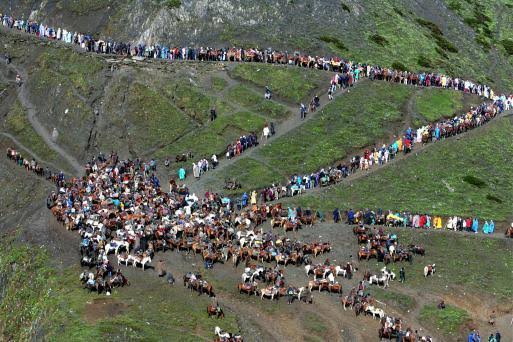
Srinagar, Jun 13: Pilgrims, undertaking Yatra to holy Amarnath cave shrine in south Kashmir Himalaya, commencing from July 1, have been advised by the authorities to avoid consuming alcohol, caffeinated drinks, smoking, sleeping pills and strong painkillers during the trek.
Officials said saree was not a suitable dress for the Yatra, adding that salwar kameez, pant-shirt or a track suit will be better. Women, who are more than 6 weeks pregnant, will not be allowed to undertake the pilgrimage.
They said keeping in view the tough nature of the trek, children below 13 year in age and elderly persons above the age of 75 years shall not be permitted to undertake the pilgrimage.
Only registered pilgrims with valid Yatra permits issued by Shri Amarnath Shrine Board (SASB) will be covered under Rs 3 lakh insurance during Yatra.
“A Yatri duly registered by the SASB for the Yatra 2019, having a valid Yatra Permit issued by the SASB will be entitled to an insurance cover of Rs 3-lakh in case of death due to accident while undertaking the Yatra,” officials said.
The Yatris were already advised to start morning or evening walks for 4-5 km at least one month before the pilgrimage to Amarnath holy cave shrine, which is at a height of 14,000 feet in the South Kashmir Himalaya.
To avoid Acute Mountain Sickness (AMS), the pilgrims were advised to start deep breathing exercises and Yoga, particularly Pranayam to improve the oxygen efficiency of the body.
They said the Yatris could avoid high altitude sickness by giving their body adequate time to acclimatise. It is, therefore, advised that pilgrims don’t over exert during the first 48 hours of arrival in the Yatra area.
“The Yatris have been advised to avoid alcohol, caffeinated drinks, smoking, sleeping pills and strong painkillers during the trek and particularly ensure against any such consumption after the appearance of any AMS symptom,” they said.
AMS is the most common form of mountain sickness and may occur after people ascend to altitudes above 2,500 m. It is characterised by breathing problems, headache, loss of appetite, nausea, vomiting, fatigue, weakness, dizziness and difficulty in sleeping.
“At higher altitudes, dehydration is common and this results in headaches. Consumption of lot of fluids, say about five litres of water, juice, herbal tea, etc, every day would be advisable,” the officials said.
They said the Yatris have also been advised to eat a lot of carbohydrate rich diet during the pilgrimage. Carbohydrate rich food is considered to be a good guard against acute mountain sickness.
“It is recommended that portable oxygen may also be carried on the pilgrimage; it is extremely beneficial, particularly for those who face difficulty in breathing,” they said.
If pilgrims suddenly develop AMS symptoms during the trekking, they should immediately descend to a lower altitude, to a place where they feel comfortable.
Yatris may also promptly put themselves on the prescribed medication and take oxygen they said, adding that efforts should also be made to contact the nearest medical practitioner/medical facility, stationed en-route by the Shrine Board, for further medical advice. Pilgrims trek should be resumed only on doctor’s advice.
“The mountains must be treated with respect and attempts to ‘conquer’ mountains or showing off physically fitness must be totally avoided. Yatris are advised to walk at a steady and rhythmic pace, preferably in a group and not alone,” they added.
The pilgrims should not fail to consume sufficient food and fluids. If they suffer from loss of appetite at high altitudes, they should consume adequate nourishment.
They said besides AMS, the pilgrims could be exposed to high altitude ailments of varying degrees, including High Altitude Cerebral Oedema (HACO), which is a severe form of AMS and occurs due to swelling of the brain tissues which may eventually impair the brain.
“Its symptoms include breathing problems, headache, fatigue, visual impairment, bladder dysfunction, bowel dysfunction, disorientation and partial paralysis,” the authorities added.
High Altitude Pulmonary Oedema (HAPO) results in respiratory failure due to accumulation of fluid in the lungs. HAPO manifests itself at night (typically the second night of climbing in high altitude areas), progresses rapidly and may lead to fatality within hours. Its symptoms include shortness of breath even when resting, persistent dry cough, bright red stained sputum, weakness, fatigue, drowsiness, chest tightness, congestion and increased heart rate. Younger people are usually more susceptible to this ailment as, in exuberance, they are inclined to over exert while trekking.
They said during the Yatra from Pahalgam/Baltal onwards, pilgrims should keep spare clothes/ eatables in a suitable water proof bag to ensure against their getting wet.